
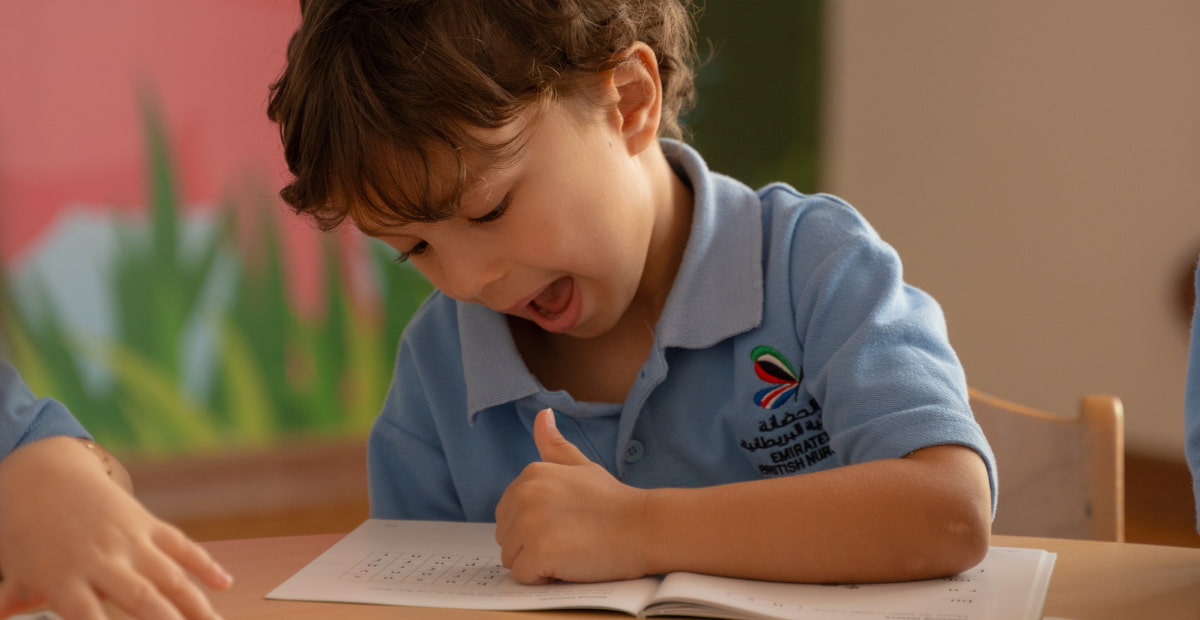
When is the best time to learn a second language? Before a child even knows they’re learning! In nurseries across the UAE, tiny voices are learning to say “hello” and “marḥabā” in the same breath. But this isn’t just a cute cultural moment; it’s bilingual education in action. And it’s laying down lifelong advantages in learning, thinking, and social development. So, what is bilingual education really, and why does it matter so much in early childhood?
What is Bilingual Education?
Bilingual education is a teaching method where children are instructed in two languages, either throughout the day or in specific subjects. The goal is not just to learn a second language, but to become proficient in both, while also meeting academic milestones.
At Emirates British Nursery (EBN), for example, we integrate both English and Arabic, ensuring children grow up fluent and confident in both languages, without compromising their understanding of any subject.
Why Is It Important in Early Childhood?
Because the early years are the prime time for language acquisition.
Children under the age of five absorb languages effortlessly. According to Harvard University’s Centre on the Developing Child, young brains are “wired to learn multiple languages,” and doing so builds stronger cognitive flexibility, memory, and problem-solving skills (Source: Harvard.edu – “The Science of Early Childhood Development”).
When bilingual education is introduced in the early years, it becomes a natural process instead of a task. This helps prevent confusion and enhances overall brain development.
Does Bilingual Education Cause Confusion in Children?
No, quite the opposite. A common concern is that children may mix up languages. However, research shows that bilingual children are excellent at switching between languages depending on the context. This ability to “code-switch” actually improves their attention control and mental flexibility (Source: American Psychological Association).
What are the Key Benefits of Bilingual Education?
Let’s break it down simply:
1. Boosts Brain Development
Bilingual children show improved skills in memory, decision-making, and attention span. These skills support academic success later in school.
2. Strengthens Cultural Identity
Children learn to appreciate multiple cultures from a young age. This builds open-mindedness and empathy, especially in a multicultural city like Dubai.
3. Enhances Communication
Bilingual children often become better communicators overall. They learn to listen more carefully, express ideas clearly, and adapt to different social settings.
4. Supports Long-Term Academic Success
Early bilingual learners are more likely to do well in subjects like reading, maths, and science because their brains are used to processing and analysing different forms of input.
5. Prepares for a Global Future
Whether your child stays in the UAE or studies abroad, bilingualism gives them a career and life advantage. It opens doors in international schools, universities, and future workplaces.
How Is Bilingual Education Delivered at Nursery Level?
In nurseries like EBN, the approach is immersive and playful. For example:
- Teachers speak in both English and Arabic during structured activities and free play.
- Storytime includes books in both languages.
- Songs, rhymes, and games introduce vocabulary naturally.
- Children are gently encouraged to respond in either language, building confidence.
Importantly, there’s no pressure. The focus is on creating comfort and curiosity about both languages.
Is Bilingual Education Suitable for All Children?
Yes. Whether your child speaks one language at home or more, bilingual education can work. Children who are already exposed to multiple languages often feel more included and empowered in bilingual settings.
Even children with speech delays or learning differences can benefit. Language specialists can tailor support, and the added language input can enhance overall speech development, not hinder it.
What Should Parents Look for in a Bilingual Nursery?
Here’s a quick checklist:
- Are both languages used regularly and meaningfully in daily routines?
- Are teachers trained in early childhood bilingual strategies?
- Does the nursery make language learning fun and interactive?
- Is your child enjoying and engaging with both languages?
If the answers are “yes,” then your child is in a strong bilingual environment.
Why Choose Emirates British Nursery, Dubai?
At EBN, we’ve embraced the bilingual advantage with care and research. Our curriculum blends the best of the British Early Years Foundation Stage (EYFS) with a deep respect for the UAE’s culture and language. With certified and highly qualified bilingual staff, nurturing classrooms, and a strong parent-partnership model, we help children thrive in both English and Arabic; not just academically, but socially and emotionally too.
Final Thought: Why Does Bilingual Education Matter?
Because language is more than words. It is a way of thinking, a bridge to culture, and a path to understanding others. When we offer children the gift of bilingual education from the start, we are giving them a head start for life.
This blog was written by a third-party


